Tuesday, August 18, 2009

The biggest bubble: China

Twenty years ago, when I was in high school, Japan Inc. was all the rage. Even in my university years (early 90s), Japan's version of capitalism was considered by academics and the mainstream media to be superior to the US.


Japan had keiretsu capitalism, whereby a group of companies were interlinked. The Japanese were hard working. They had to be forced to take vacations. They were smarter than Americans (or Canadians). They were buying up prized American assets. They had lifetime employment.

In reality, they had a huge stock market and real estate bubble. They had poor demographics (they did not enjoy the baby boom post WWII for obvious reasons). Their smart workers were not as creative as the "fat and lazy" Americans (look it up: that is what one official called Americans back in the early 90s; also a fantastic SNL skit with Mike Meyers). They are good at high end manufacturing (witness Toyota, Honda and Sony) but I'll be surprised if anyone can name any high-tech startup from Japan with any international significance. Keiretsu capitalism is now known as crony capitalism. Their banking system was insolvent. We now know that their system was not very adept at dealing with poor economic times, and their reaction to their depression was quite poor and not very dynamic.

All this is not to Japan bash. In fact, their story is remarkable. The Japanese are a smart and hard working people. They rebuilt their economy after the devastation of WWII (imagine the loss of millions of citizens and 2 cities being annihilated by nuclear weapons!) in one or two generations. I believe that things got ahead of themselves in Japan in the 80s and their system was not built to succeed for the 21st century (with creative and dynamic companies). I also believe that when this global recession/depression ends, Japan will fully participate in a recovery.

Again, when I was a young kid, the USSR was feared. Their hockey teams and Olympic teams were dominant. In Hollywood, their characters were always tough villains (think Rocky 4) or they were ready to launch nukes on us. On TV, their pre Gorbachev communist leaders were old and scary. Their military was very powerful and we were always worried about doomsday clocks and nuclear war.

In reality, the Soviet Union was a paper tiger. Yes, they had nukes but their economy was in shambles and much of their military was dysfunctional. We confirmed that totalitarian communist governments don't work. Their union was a joke and many of the countries that they kept in the Union by force either became separate countries or are still trying to get there. The Russian people were not to be feared and they wanted many of the freedoms that we have.

Why the history lesson from the eyes of someone born in the seventies? Because I am now old enough that I feel as if I have seen this story before. I am talking about China.

China has some strengths but unfortunately, it shares some of the worst qualities of Japan and the USSR.

China is a one party totalitarian government. To their credit, they have moved away from communism, but nonetheless, the central government has a ton of control over the economy. The recent stimulus is a case in point. The central government is also very involved in banking and fixed investment, which is supporting the economy at present, despite a huge drop in exports. We currently fear the Chinese military, although not to the extent of the USSR circa 1985. We all remember the disgusting Tienanmen Square massacre of 1989.

China is similar to the USSR in that it too is not truly a union. Tibet and Taiwan are two of the high profile cases. However, much of China is not homogenous. You have Christians, Muslims, Buddhists and different ethnic groups. You also have hundreds of millions of rural and mostly uneducated citizens as well as hundreds of millions of educated and urban Chinese that live centuries apart. All these interests are united by a totalitarian government. It is unlikely that China will stay together in the future. At some point in the future, China may well have the same problem that the USSR did and fragment.

China is also similar to Japan 1989, in that the West is so bullish on China, that they are suspending all rational thought.

Take a look at this gem of a quote from a survey discussed in Bloomberg:

Two-thirds of respondents say they are optimistic about India’s prospects, as are 70 percent on China. “The Chinese economy is run by the government, managed by the government, helped by the government,” says Omri Beer, an options trader at Nomura Holdings Inc in Tokyo. “It’s easy to be bullish.”

Or the Yuan as a global currency. It is not even the dominant Asian currency. It is not even freely traded. Even the respected Nouriel Roubini has been talking up the Yuan as a replacement to the US dollar. I vehemently disagree. One day, the Yuan may be considered in the same light as the Japanese Yen, but not as the senior world currency. Not any time before 2050 and probably not at all. It took the US dollar decades AFTER it surpassed the UK economy, and two world wars, BEFORE it became the dominant world currency. Even if China becomes the dominant world economy one day, it may take decades after that for the Yuan to become the dominant world currency.

Most in the West believe that the Chinese government is so wise and all-knowing. Their stimulus plan is genius. Their management of the economy is superior to a market based economy. They are combining the best of communism and capitalism. Their stockpiling of copper is genius, despite prices being historically high. Their GDP is growing while ours is shrinking.

The reality is very different. Have you seen their leaders? I wouldn't trust them to run a multinational company let alone one of the biggest economies in the world. Sadly, I could say the same about President Obama, but I digress.

I wouldn't trust any number coming from their government. Studies have shown that their GDP numbers are way too smooth given the relatively early stage of development that their economy is in. So when they report GDP, take it with a grain of salt. I will acknowledge that their stimulus appears to be "working". Yes, because they are forcing banks to lend, fixed investment to continue regardless of return on investment and people to consume. This can work for a short period of time, until the banking system is shown to be insolvent (Japan), the fixed investment ponzi scheme is exposed and the demand from consumers is saturated.

Their exports are mostly based on being the lowest cost and the quality is often suspect. Part of the low cost is the huge labor surplus and part of it is the manipulation of the Yuan. I suspect that China will attempt to move upmarket in the future, but I don't believe that the Chinese share the Japanese' love of quality. Also, there is again the same problem that the Japanese have with creativity and innovation. Name a truly international multinational coming out of China that is changing the way we live, like RIMM or Apple?

I have no idea when the China bubble will burst, but when it does, I think it will rival Japan's bust. It may not last 20 years but 10 years is a definite possibility.

I know the math about how China gets to be the dominant world economy. You take 4 times the US population and 25% of the GDP per capital of the US and presto, you get the biggest economy in the world. If only it were so easy. That population could shrink in a fragmentation scenario and their GDP is inflated by their own bubble. Again, I don't think the Chinese people are any different than you or me. They want the same freedoms and opportunities that we have. Many of them have immigrated to Canada, and they are a great asset for us. I just don't think that the Chinese system is superior and I believe that over the next decade, China will be derided for all of its mistakes.

Disclosure: position in FXP.

Monday, August 10, 2009

$17 OIL

Last July, near the $147 oil & TSX 15K high, I put out an outlandish target of $60 oil and TSX 9000. Ultimately, in the depths of the winter despair, oil hit $33 and the TSX 7,500.

Now that we are about 100% up in oil ($74 was the high) and the TSX has rallied to 11K, and the bulls are strutting, I wanted to put this out.

Even prominent bears such as David Rosenberg believe in the commodity super bull market. He points that even at the lows of 2008/09, all commodities had higher lows than earlier in the decade (2001-2003). Take oil for example. It bottomed at $17 in 2001. It bottomed at $33 earlier this year.

My problem with that view, is that it assumes that those lows will hold. (And they might).

I take the view that the credit bubble that inflated profit margins, housing values, stock market valuations also inflated commodity demand. You could make the argument that things are worse today for the economy than back in 2002/03. Therefore, demand does not necessarily support prices at $74 let alone $33. I understand that BRIC demand is way up since then, but that does not compensate fully for the drop in G7 demand, nor does it preclude a continued drop in BRIC demand as their exports continue to get smoked. Also, the commodity boom allowed tons of supply to come on stream making supply much higher than it did back in 2002/03. Throw in all the consumers that got religion on energy conservation from years of high prices and the green movement. Heck, even I just bought a front load washer because I calculated that it will save me some money over its lifetime. SUV demand is not coming roaring back despite the 50% drop in oil prices. Companies are looking to cut costs, including energy costs.

If we are in a sustainable recovery, then I agree, forget about $17 oil. If we are in a L or W shaped economy, then $17 oil should be on the table. Even back in the prosperous days of 2005, with the Katrina effect, we didn't surpass $70 oil. And here we are in the steepest global recession since WWII, and oil prices are at $74. Inventories are at multi year highs.

Philip Verleger's view are right on, in my view. Not necessary that we get there in 2009, but I think that $17 or $20 is much more likely than $100.

Saturday, August 8, 2009

Updated jobs prediction

Back in early February, when economists were talking about 8% unemployment by year end (we hit that in spring!) and shuddering at 8% unemployment and 325,000 job losses by year end, I made this prediction that seemed somewhat alarmist:
For 2009, I would look for an average of 50-60K in job losses (600K-720K annualized). This is optimistic, and it could be worse. I project an increase to 9% or 10% unemployment by the end of 2009.
I also predicted
it (unemployment) will be at 8% in April. By mid year, at the absolute latest. 9% by year end is looking conservative. Remember in the last 2 recessions, unemployment went to 12%.

In this job loss hurricane for the next few months, 50 to 100K should be the range.
Let's revisit this:

When did it hit 8%? April. good prediction
9% by year end? That is now the consensus (doesn't mean it will happen, but no longer outlandish). 10% I address in my prediction below.
In the job loss hurricane (which ended in March, as I acknowledged on May 11th when the April numbers were out) 50 to 100K was about right.
So far in 2009, job losses YTD are 331K. That projects to roughly 662K by year end, again roughly in line with 600K-720K. Too early to say...

Notes on the July numbers:
Every month, we get tons of new self-employment jobs (75K and fluctuating wildly since October). That to me is complete BS. That number is way too high and volatile to be believable. Since my predictions thus far have been quite good on the jobs front, I am now going to make predictions excluding this number, as it seems silly. I will predict the numbers ex self-employment.
The July losses excluding self-employment were 79K. That is astronomical for an economy supposedly exiting recession. Even when you add the 35K of self-employment, the number becomes 45K. Now, some of the July losses were probably due to the fact that April and June were quite good. Perhaps August will be better. Also, interesting that Quebec finally had a bad month (-37K; more than 50% of the job losses since October). I live in Quebec and I am shocked and stunned by the complacency here. Quebec is on a different planet. Perhaps this report will take Quebec from a 2007 mentality to something closer to 2009.

Now for my new predictions:

1) Unemployment in the low 9% range by year end. 10% will only happen (I don't want it to happen) if we get a repeat of last fall's market carnage.
2) Lowering the job losses excluding self-employment to the lower end of the range (600K). We are close to 400K right now, so this is a deceleration from the first half. The 720K only happens if we get a repeat of last fall's market carnage.
3) The jobs report be relatively good for August & September as companies become more optimistic that the economy has bottomed and therefore, they don't lay off as many. October to December may be very bad though as I believe more people will realize that this optimism was misplaced, that this was not a regular recession and the recovery will be anemic. Again, this assumes no market carnage.

Wednesday, August 5, 2009

Go ahead, buy a house if you can handle it

Interesting question from an anonymous reader. It would preferable to have a name and maybe some followers (on the top right of the site), but I digress:


I have been following your articles which stop me from buying a house.... and now the housing prices have been going up, up and up... I cannot even afford a house now... please tell me if the housing prices will ever go down again.. please...


Please don't use my blog for direct advice on buying a house. I'll leave those decisions to you and your family. I have my views, which I am sharing, but no one is always right and you will have to live with whatever decision you make.


I still don't see how housing in Canada can be immune (the only country in the world?) to the deflationary forces out there. Anything is possible, though. I suspect that CMHC and the oligopoly (govt & banks) are responsible for keeping credit flowing. Record low rates and prevailing sentiment that Canada prices aren't going down are keeping the bubble alive.

Does it make sense to me that the same house in Canada costs 2X a house in the US (a recent study showed this)? We have more land, less people, crummy weather, no interest deductibility on our taxes, lower salaries, higher taxes. Either our prices are way, way overpriced or theirs are way, way underpriced. I suspect the former. People in Canada are all esctatic that our prices haven't gone down much while US prices have gone down 30%. That tells me that maybe our prices are overpriced. Instead, the real estate industry tells you that this is automatically a good thing.

Believe me, I have everyone I know telling me the same thing: Canadian housing prices are not going down. You were wrong.


Perhaps, but only with the fullness of time, will we know. I am currently moving from one rental to another rental. I don't want to buy now for a few reasons but one of the reasons is that I am very worried about a 30% minimum decrease in my equity. That means if I put 30% down, I get wiped out. I personally have difficulty sleeping with that type of risk. I think that we are at or near lifetime highs in real housing prices (meaning after inflation).


Even if you don't buy my views, ask yourself what happens if housing prices decline 30% over the next few years. That would only take prices to where they were earlier in the decade. If you can afford a 30%+ decline in your house equity and still live a happy, healthy life, then go ahead and buy a house. I have family members who have bought in the past few years because they could answer yes to that question.


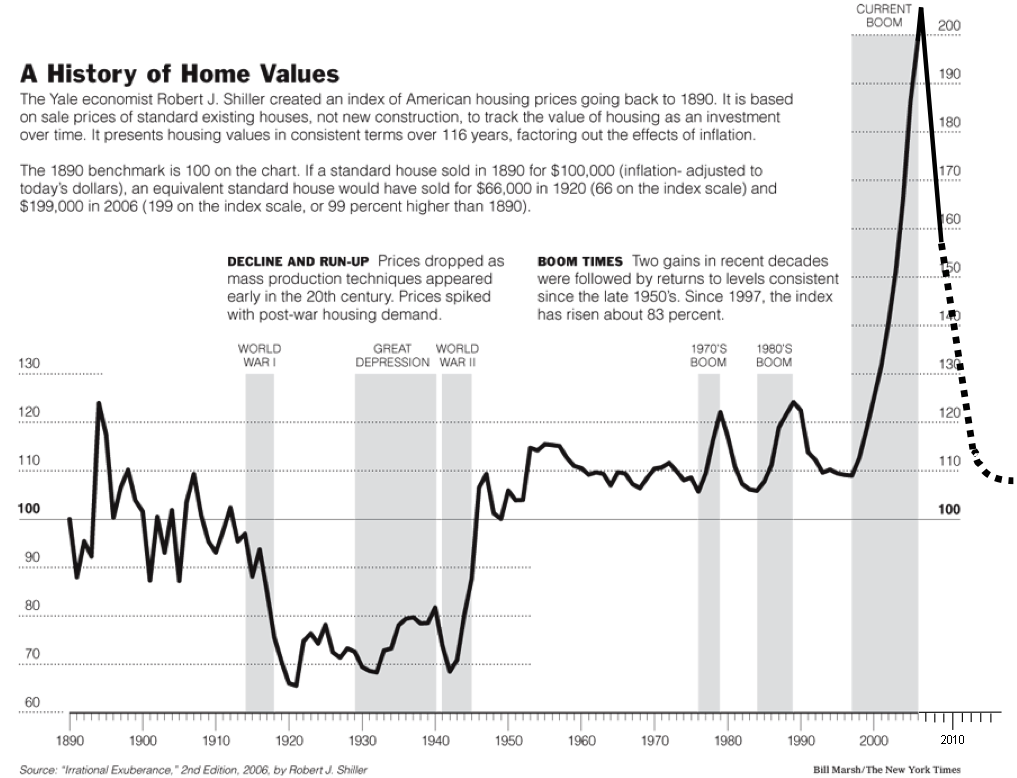
The fact that the question is posed in such a desperate way tells me that this a bubble as people are thinking that prices are running away from them again and that they better buy soon. Historically (based on US history however), Professor Schiller has demonstrated that after-inflation, housing prices basically do nothing over decades. I wish there were a similar Canadian chart (there is no frickin' info in this country!). We are probably at a very similar place to where the US was in 2006. If you wish to pay roughly 2X the real value of a house, then be my guest. Also, realize that overvaluation or undervaluation can last for years and even decades. I suspect that we are heading for a long period of at least fair value or undervaluation.


Hope this helps clarify my views. Read my blog and other blogs that are bullish. If my reasoning resonates, it may be because you have some of my worries. If you think that I am wrong, please feel free to read all the stuff coming from bullish blogs or CREA.


Thank you for the comment

Sunday, August 2, 2009

Hard being a bear

It is hard being a bear these days. The S&P has bounced to a new YTD high. Commodities and corporate bonds continue to improve. The overwhelming consensus is that the worst is over, even by some of the big bears who saw this coming, such as Nouriel Roubini. ECRI continues to talk about an imminent recovery and actually removing stimulus. The central bankers and politicians are all patting each other on the back about moving the economy away from another Great Depression (ironically after downplaying even a garden variety recession for much of 2008). Despite the fact that there a few real signs of green shoots, the bulls are optimistic and talk as if the recovery was already well under way.


Magazine covers (Newsweek) and many of the "man on the street" are all talking about how the recession is history (the Bank of Canada said so!). I am getting a lot of grief from people about "see Canadian housing prices have hardly dropped. In Montreal, they didn't even drop!". I am surprised by how much confidence there is right now and by the complacency.

I may be completely wrong about all of this (continued recession for 2009 & a breaking of the March lows this year) or all this optimism about an imminent and powerful recovery is the natural contrarian setup for that downturn.

The short positions that I reapplied between S&P 930-950 or about 5% ago (after thankfully covering for small gains around 890-900) have now been mostly covered for losses when the S&P broke through 985 last week, as a belated show of discipline over conviction.

We are now entering what I believe to be the critical month of August. I have long ago flagged this as a natural beginning to the next downleg. That window is now open and some of the research that I follow point to a possible blow-off top climaxing this coming week. Monday will be Day 16 of a classic buying stampede. Most buying or selling stampedes last between 17 to 25 sessions and are characterized by a clear trend with only 1.5 to 3 day counter-trend moves before going to new highs/lows (thanks to the bullish Jeff Saut at Raymond James for this). That translates to either this week or next. A number of important cycle indicators and historical patterns also point to this week as a critical week. We have a key employment report on Friday.

A key area is that former resistance of 940-956. I will be watching carefully to reapply my shorts (in an even bigger way) if I start to see signs of waning momentum.

Only time will tell, but the time for the bears to make their stand is within the next few weeks and months.

Sunday, July 26, 2009

Carney: Recession is over!

Mark Carney made headlines this week as he proclaimed that the recession is over.


This post will not be to critique his forecast, although as you may guess, I am skeptical. This post will cover how much it is dangerous to put too much faith any one person's forecast (including yours truly).

Carney is stating that GDP will grow this quarter and forever so by definition, that makes this recession over. Time will tell.

The combination of his declaration (and similar ones from Bernanke and other central bankers) combined with the sharp rally since March, with the new highs of this past week, has the bulls sitting pretty, and bears like myself, look very wrong.

A very close family member asked me today if he should reduce some of his high cash position due to this rally and Carney's comments.

Watch the bank economists get all giddy by Carney's words.

"It is there in black and white, that the recovery has effectively begun," said Douglas Porter, deputy chief economist at BMO Capital Markets. "I think it is astonishing how quickly the economy turned to the good in the last four or five months."

He may be right. Perhaps GDP will be positive this quarter. That does not necessarily mean that the recession is over. Recession can have positive quarters. Carney may also be wrong. We are only 25% of the way through the third quarter. There is nothing written in stone that this quarter will be positive. Recession ending? Let's wait and see, but I am very skeptical.

Let's also remember another bold forecast by Carney (again, he may be right this time):

From almost exactly 1 year ago today (July 17/08), from the Toronto Star:
today's update on the central bank's thinking, governor Mark Carney expressed hope that the worst might be over for the Canadian economy, which slumped badly in the first three months of 2008 but could slowly rebound in line with a recovery in the United States.

My comment: The worst hadn't even begun. Terrible forecast.

As a result, Carney indicated the bank, which held its trend-setting overnight rate at 3 per cent on Tuesday, will be no hurry to adjust rates up or down.

My comment: There was a hurry: to drop rates to zero.

The bank says "a gradual recovery in the U.S. economy" and other factors will help Canada's economy pick up steam early next year and return to normal growth in 2010.

My comment: How did that gradual recovery work out for you. Pick up steam? Yeah, the steam from a train going off the tracks!

But the 8-page "Monetary Policy Update" issued this morning concludes that "growth in the United States could also be weaker than expected, particularly in those sectors that are most relevant for Canadian exports."

The bank has consistently underestimated the impact of the U.S. economic slump on Canada's business conditions. At the beginning of the year, it forecast 2008 growth in Canada at 1.8 per cent but has now nearly halved that estimate to 1 per cent growth--the worst performance by the Canadian economy since the early 1990s.

Today, the bank said it missed the mark because growth in household spending fell short and a drop in inventory investment - after a buildup in late 2007 - was steeper than it had thought in April.

It also said today that, because of high oil prices, consumer price inflation in Canada will peak at 4.3 per cent in the first months of next year, a level well above the bank's target of 2 per cent.

But Carney predicted that as energy prices stabilize next year, inflation is likely to return to the 2 per cent level.

My comment: Oil prices plummeted, again not forecast by Carney & Co. Inflation was peaking back then and not in first months of 2009. Energy prices did not stabilize and fell to $33 early in 2009, from $147 in July 2008. They have stabilized around $60-70 (for now) but not at $147.

Again, this post is not to criticize Carney's current forecast, only to point out that his crystal ball is about as murky as they get. I have chosen July 2008 since it was exactly a year ago and it shows the danger of false hope.

Millions of Canadians, including family members of yours truly, are putting some faith in Mr. Carney's proclamation this week. I am just saying to have some healthy skepticism as he has made some poor predictions before, and he is basically a cheerleader for the Canadian economy. The history of these types of post-bubble credit contractions are such that the establishment types often proclaim victory at the most dangerous moments. Perhaps this time will be different?

Thursday, July 23, 2009

Stampede

The bulls are stampeding higher on "strong" earnings. Most companies have nicely beat earnings on the back of cost cutting (ie layoffs, drop in spending). This game can continue for a little while, but for the rally and the recovery to be real, either consumer or business spending is going to have to recover.

I have mentioned that often there are key turning points in the stock market around July 17-22 (look up charts on 1981, 1982, 1987, 1990, 1998, 2001, 2002, 2007 & 2008). As I write this on July 23, the S&P is stampeding higher to 968, breaking the January & June highs. Assuming that 2009 did not have a key turning point around July 17-22, this gives the market the opportunity to ramp into the first week of August. There are a number of cycle turning points that point to a significant inflection point around that time.

I would imagine that this time window of another 2 weeks would give the market time to get to 1000, which would equate to a 50% rally from the 666 low.

I have yet to hear from any major company (especially those that beat on their earnings) that there is anything more than a minor recovery in underlying end demand. In the past 2-3 quarters, companies have been hit a double whammy of by slowing end demand by customers AND a slashing of inventory levels by these customers. In the past quarter, the slashing of the inventory has mostly ended (and even reversed in some cases due to optimism about Q3 & Q4) and the drop in end demand has stopped and stabilized.

The hope is that inventory rebuilding is indicative of a coming recovery and the stabilization of end demand (or marginal pickup due to pent-up demand) will lead to some type of recovery in final end demand in Q3 & Q4. So far, IMHO, there is no proof of this recovery in final end demand beyond a possible blip due to demand that was suppressed during the Crash of 2008.

The other interesting thing is that companies are saying that they see little or no impact from the Obama stimulus. If you are bullish, you could interpret this as a positive since that impact may be coming, but if you are bearish, you could use this point as proof that this rebound is simply part of the ebb & flow of a super bear market. Also, much of the confidence in this rally has been supposedly caused by confidence that the government has saved the economy from the abyss, as President Obama took credit for doing yesterday.

What am I doing? As I mentioned, I called an audible and sold most of my ultrashorts around S&P 890ish. Unfortunately, I have bought them all back from roughly S&P 930 to 950, meaning I am underwater on them. Presently, I am planning to hold these and put aside discipline, as I have a strong conviction that August and September are going to be very, very ugly. I have room to add to my ultrashorts (and put options) but I will wait for some clear signs that the stampede is ending (think Wile E. Coyote off a cliff) before doing so.

I suspect that a slew of discoveries in the banking sector worldwide are imminent and when the "green shoots" talk is put to rest, there will be a very quick and deep drop in confidence.

Disclosure: positions in USD, Yen, CAD, ultrashorts in oil & various equity indexes, selected equities & puts, long gold.